
We have been experiencing some problems with the photos on this blog; for a while today, all the images were unavailable. This is one of the reasons why we have decided to move our blog, it also means we can use our snazzy domain name! All new posts will now be on the new site.
http://teamtarka.co.uk/
The new site will be easier for us to update from the states, so you shouldn't miss any of the action.
Monday, 29 March 2010

Tuesday, 16 March 2010
Sprint Propeller Started
The EDMC have started to manufacture our propeller today. So far, they have cleaned up the billet of aluminium and machined out the taper for the prop shaft. Next they will cut the keyway before starting machining of the blades tomorrow.


Sunday, 14 March 2010
Carbon Fibre!!!
The inside of the boat is now nearly complete. We just need to work out the engine mounts and put in the final bulkhead.


Saturday, 13 March 2010
Photos of the boat (in progress)
Here are some photos of the hull being built. You can probably see just how messy epoxy resin is to work with!


Thursday, 11 March 2010


Monday, 1 March 2010
Messing about in a boat
Today we blew the cobwebs off of last years boat. We took it out for a spin for a photographer (these are not his pictures!).
We took the opportunity to do some real world testing whilst on the water and set up a differential GPS system to collect centimetre accurate position and speed data. We tested the boat with and without an interceptor - a device to control the trim that we are planning to implement on the new boat. It was surprisingly effective. With the interceptor, the boat rode very flat with little wake. We are still analysing the GPS data to work out exactly how much difference it made in the real world, but here are some photos of the day!


We took the opportunity to do some real world testing whilst on the water and set up a differential GPS system to collect centimetre accurate position and speed data. We tested the boat with and without an interceptor - a device to control the trim that we are planning to implement on the new boat. It was surprisingly effective. With the interceptor, the boat rode very flat with little wake. We are still analysing the GPS data to work out exactly how much difference it made in the real world, but here are some photos of the day!


Tuesday, 9 February 2010
Building Tarka II (Part 1)
After the model testing, we were pretty happy with the design. Now its time to start building the real thing!
We got the frames water jet cut in Portsmouth. These were then screwed to our extremely sturdy and perfectly level eleven legged table - that got some funny looks in Ikea, I can tell you! Stringers were then fitted into recesses in the frame to form the shape of the hull!

We tapped up all of the frame with parcel tape - fingers crossed this will help release the boat from the frames when it is complete!
We next added core cell foam to the frame work which is very stiff until you heat it up. When it is warm, it is flexible and allows easy forming over the frames. This allows us to get a nice smooth shape that we can later bond the carbon fibre to!


Coming soon... Carbon Fibre photos and timelapse of the build so far!
We got the frames water jet cut in Portsmouth. These were then screwed to our extremely sturdy and perfectly level eleven legged table - that got some funny looks in Ikea, I can tell you! Stringers were then fitted into recesses in the frame to form the shape of the hull!

We tapped up all of the frame with parcel tape - fingers crossed this will help release the boat from the frames when it is complete!
We next added core cell foam to the frame work which is very stiff until you heat it up. When it is warm, it is flexible and allows easy forming over the frames. This allows us to get a nice smooth shape that we can later bond the carbon fibre to!


Coming soon... Carbon Fibre photos and timelapse of the build so far!
Tuesday, 12 January 2010
Tank Testing (Take 2)
Time for the second set of tank testing. This time with the new hull! Same tank as last time (Solent Uni) but this time with a bigger model. We went for a 1/3 scale model instead of the 1/4 scale that we used last time to give us more weight to play with. Last time it was very difficult to do everything with 200 grams of ballast weight, this time we have 2.5 kilos to move about!

This was one of the endurance runs. You can see the trim has been adjusted to get the bow in the water and the transom just out of the water. This gives the lowest resistance at the stern of the boat and only slightly increase wave making resistance (energy used to make the wake). This looks like it could be a winning design for the endurance race...

This is a sprint run. So shouldn't the bow be out of the water? Well no. The model was fitted with an interceptor (a trim control device) to keep the trim flat and reduce resistance - you can see the spray from the interceptor at the stern! Amazing what 5 millimetres of vertical planking at the stern can do!

This was one of the endurance runs. You can see the trim has been adjusted to get the bow in the water and the transom just out of the water. This gives the lowest resistance at the stern of the boat and only slightly increase wave making resistance (energy used to make the wake). This looks like it could be a winning design for the endurance race...

This is a sprint run. So shouldn't the bow be out of the water? Well no. The model was fitted with an interceptor (a trim control device) to keep the trim flat and reduce resistance - you can see the spray from the interceptor at the stern! Amazing what 5 millimetres of vertical planking at the stern can do!
Tuesday, 8 December 2009
Model Building Tarka II
The model for Tarka II was built in pretty much the same way as Tarka I, using frames and strip wood planking. I won't bore you with details again, but here are some pictures of the model in build.


Tuesday, 24 November 2009
Tank Testing (Take 1)
Its taken weeks of standing out in the freezing garage superglueing our fingers to thin plywood strips. We've gone through several trees and an entire beach worth of sand paper, but the model is finally ready.
Today we took it down to the towing tank at Southampton Solent University. Their tank is 60 meters long and allowed us to test (at an equivelent speed of 17 knots).
The model is fixed to a carriage that sits on rails via a post. The carriage can then be sent down the tank at precise speeds and the resistance of the model can be measured.

The model is sent down at a series of speeds, correcting the trim each run and then a resistance curve can be produced which will give the naked hull resistance of the boat at any speed. We can use this to estimate the amount of power required to reach certain speeds.
We ran tests in the sprint and endurance conditions and the data should prove invaluable to help us design the new boat.
Today we took it down to the towing tank at Southampton Solent University. Their tank is 60 meters long and allowed us to test (at an equivelent speed of 17 knots).
The model is fixed to a carriage that sits on rails via a post. The carriage can then be sent down the tank at precise speeds and the resistance of the model can be measured.

The model is sent down at a series of speeds, correcting the trim each run and then a resistance curve can be produced which will give the naked hull resistance of the boat at any speed. We can use this to estimate the amount of power required to reach certain speeds.
We ran tests in the sprint and endurance conditions and the data should prove invaluable to help us design the new boat.
Monday, 16 November 2009
Model Building Tarka I
We have been set the challenge of redesigning the hull for Team Tarka. The rules of the competition mean that the hull must be optimised to fit somewhere between being really efficient at low speeds (for the endurance event) and being really efficient at high speeds (sprint event). These two cases require a hullform with completely different features.
Before we start designing the new boat, we need to get a better idea of the performance of last years boat. We want to get some accurate data from some towing tank tests.
To do this, first we need to build a completely accurate scale model of last years hull.
 We started by getting some frames (bulkheads) laser cut from 4mm thick marine grade plywood. These form the basis of the model and ensure that the shape of the hull is accurate.
The next challenge was to glue even thinner plywood (1.8mm) to the frames to form the hull of the boat. This took a suprising amount of time! Once the strips were glued on, they were faired - so much sanding...
 The finished hull was then ready for a thin layer of GRP and painting - more sanding!
The boat then went on a major weight loss regime, losing most of the longitudinal (fore-aft) structure and all the bulkheads were cut down.

Before we start designing the new boat, we need to get a better idea of the performance of last years boat. We want to get some accurate data from some towing tank tests.
To do this, first we need to build a completely accurate scale model of last years hull.
 We started by getting some frames (bulkheads) laser cut from 4mm thick marine grade plywood. These form the basis of the model and ensure that the shape of the hull is accurate.
The next challenge was to glue even thinner plywood (1.8mm) to the frames to form the hull of the boat. This took a suprising amount of time! Once the strips were glued on, they were faired - so much sanding...
 The finished hull was then ready for a thin layer of GRP and painting - more sanding!
The boat then went on a major weight loss regime, losing most of the longitudinal (fore-aft) structure and all the bulkheads were cut down.

Wednesday, 30 September 2009
Team Tarka 2010 first meeting
After the long summer, team Tarka reconvened today to begin planning for the 2010 competition. Early days yet, but we have new people on board, a new team captain, Jon Burton, and much stronger links to the ship science group. It should be an exciting year ahead.
First date for the diary is the 20th October, when last year's team will give a talk at the IEEE student branch. See the IEEE site for more information.
First date for the diary is the 20th October, when last year's team will give a talk at the IEEE student branch. See the IEEE site for more information.
Friday, 12 June 2009
Team Tarka featured on Eland "Reel Life" blog
Eland cables have added an entry to their reel life blog about team tarka, and the important part that Eland played in getting our boat ready for the competition.
Monday, 1 June 2009
Final Results
So, the end of Project Tarka has arrived with the following results today:
3rd place qualifying event
Winners : Teamwork Award
Winners: Best Score for a rookie team
Winners: Sportsmanship Award
Overall Place : 10th
We had three excellent sprint results today, with three consistent runs of 47s, 47s and 50s (with an experimental prop angle and not fully charged batteries). Karim drove very well under difficult conditions, and the boat looked great. Karim also now knows the new technical term "give it the beans!"...
Yesterday was a highlight, with the morning run a tactical error on the power management front leaving us short on battery power too early and 14 laps completed, but the second run was simply *outstanding*, with 17.75 laps completed and one of the best pieces of overall teamwork I've ever seen.
Dirk driving to a schedule superbly, Karim doing Telemetry and working really hard to get it working and then providing fantastic numbers, Rich on race tactics and superb radio, and myself on the Radio point on the dam overlooking the race and providing wind and race status to Dirk and the guys. The outcome was joint first in the standings in the Silver medal race, and a really exciting race, from being lapped early on, to a two hour chase of the leading boat which we caught up on the final minutes with the batteries giving out as the finish hooter went...it was fantastic...
From an engineering standpoint we had *no* problems with any of the engineering, and the boat was running on its limits all week - it could have not been run better. The best compliment paid was almost every team saying "we need to watch out for your guys next year".
Many thanks for all your help, hard work and commitment - and I hope we've done everyone proud with this rookie outing, exceeding my expectation. Getting into the top ten was a dream this year, but I didn't really dare to hope we'd actually do it- the strength of some of the teams is just scary. This means that we now know our number for 2010 - number 10 - as only the top ten boats get a number for the following year.
So, now the work starts for next year, but we'll have a party around the boat when I get it shipped back (we packed it all up in the crate today), and acknowledge everyone's efforts when we all get back.
Cheers,
Peter

(Image courtesy of Scott Miller http://sjmpix.zenfolio.com)
3rd place qualifying event
Winners : Teamwork Award
Winners: Best Score for a rookie team
Winners: Sportsmanship Award
Overall Place : 10th
We had three excellent sprint results today, with three consistent runs of 47s, 47s and 50s (with an experimental prop angle and not fully charged batteries). Karim drove very well under difficult conditions, and the boat looked great. Karim also now knows the new technical term "give it the beans!"...
Yesterday was a highlight, with the morning run a tactical error on the power management front leaving us short on battery power too early and 14 laps completed, but the second run was simply *outstanding*, with 17.75 laps completed and one of the best pieces of overall teamwork I've ever seen.
Dirk driving to a schedule superbly, Karim doing Telemetry and working really hard to get it working and then providing fantastic numbers, Rich on race tactics and superb radio, and myself on the Radio point on the dam overlooking the race and providing wind and race status to Dirk and the guys. The outcome was joint first in the standings in the Silver medal race, and a really exciting race, from being lapped early on, to a two hour chase of the leading boat which we caught up on the final minutes with the batteries giving out as the finish hooter went...it was fantastic...
From an engineering standpoint we had *no* problems with any of the engineering, and the boat was running on its limits all week - it could have not been run better. The best compliment paid was almost every team saying "we need to watch out for your guys next year".
Many thanks for all your help, hard work and commitment - and I hope we've done everyone proud with this rookie outing, exceeding my expectation. Getting into the top ten was a dream this year, but I didn't really dare to hope we'd actually do it- the strength of some of the teams is just scary. This means that we now know our number for 2010 - number 10 - as only the top ten boats get a number for the following year.
So, now the work starts for next year, but we'll have a party around the boat when I get it shipped back (we packed it all up in the crate today), and acknowledge everyone's efforts when we all get back.
Cheers,
Peter

(Image courtesy of Scott Miller http://sjmpix.zenfolio.com)
Saturday, 30 May 2009
Day three
For a day with less than a minute of boat running today was intense. Our boat is running well and we are slick at running it. We performed as predicted in the sprint race, losing some ground with a time in the middle of the field. We are happy, however, that it will not jeopardise our competitive ranking and we envisage a recovery with our strong event; the endurance race. Our commitment to assisting the Mexican team in their qualifying efforts came to a head this morning; after their near sinking yesterday they found their motor to be inoperable. Despite being the smallest team we split up for an ultimately unsuccessful attempt at repairing their systems. The boat was almost completely rewired by myself with help from representatives from Carnegie Mellon and Cederville universities; within 45 minutes. The proprietary brushless motor, being tied into the system's controller, prevented the necessary controller replacement from being possible; ultimately consigning the Mexican team to a retirement from the competition. In the meantime as well as running the battery charging strategy and preparing the boat for competition the rest of the team fine tuned the telemetry system to extend its range; not strictly necessary but a luxury to confirm the accuracy of our readings. Our lasting impression of the day remains the New Orleans boat which ran a 23 second 300m, its acceleration is literally explosive.
Richard, Team Tarka
Richard, Team Tarka
Friday, 29 May 2009
Day two report
Another succesful day on the water gave us cause for encouragement. As we departed from the paddock area we were leading the event overall but with the top teams still to qualify we await further results with baited breath. Our major limiting factor currently is the boat's propellor, with such a low pitch we are unable to deliver the copious power that our electrical system is able to generate; causing us to lose a couple of seconds in the sprint racing over our rivals. Given the nature of the competition, however, we are confident this will not stop us from maintaining a high ranking. Our lead in the, all be it restricted, standings is in no small part thanks to our placing of 4th in the scoring for the technical reports. It was quite something watching some of the faster boats sprinting and I, for one, would love to have a greater emphasis on speed in the marking to encourage more high speed development. Given more support in the future we will be back with a competitive high speed configuration. Less fortunate were the Mexican team who employed our assistance in retrieving their sinking boat, which had been damaged in transit. We hope they will be able to patch the holes and qualify in time tomorrow. Good luck guys.
Richard, Team Tarka


Richard, Team Tarka


Thursday, 28 May 2009
Contest day one.
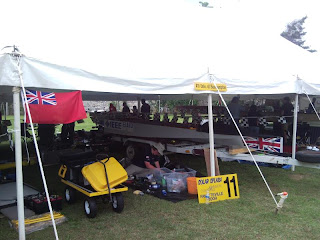
Today saw the start of the organised event and we pitched up with our towels earlier than everyone else, not because we're organised but because we're still waking up at 6am. We were subsequently moved on but were fortunate enough to be placed next to last year's winning team, from whom we intend to learn much. With a little fettling we passed the technical inspection, although we're still to find out whether they will allow our batteries as they are on the borderline of being too heavy. People seem to like our boat and the general consensus appears to be surprise at the speed with which we were able to construct it. Our work space accommodates us easily, especially when compared with the larger crews and they are all larger than ours. The boat spent the day standing proud, the most obvious boat from the entrance and looking smart with all its sponsorship decals, the union flag welcoming all interested parties. Interested parties were in plentiful supply throughout the day and I've become used to being introduced as 'Richard, the one you won't understand'. We left the boat this evening ready for our seaworthiness trials tomorrow morning and headed for a provided supper at the university football team's stadium. Some more calculations await our attention this evening, as does a pack of beer.
Richard, Team Tarka

Richard, Team Tarka


Wednesday, 27 May 2009
First update from Arkansas


After spending yesterday fixing the multitude of broken boat parts we were able to commence testing today. The boat was run for approximately 4 hours in variations of the endurance configuration. A close to optimum configuration has been found and further analysis of data later tonight will allow us to select a number of parameters that are still unclear. The boat performed well and we are optimistic that it is competitive, in the endurance configuration; based on the information gleaned from local competitors. We are prepared to be shocked by the speeds that the faster boats may reach in the sprint configuration. Observations have shown that the local boat uses two motors, which are identical to our one; an extravagance we simply could not afford. The custom props are another significant difference that with extra funding and time next year we intend to consider. Despite our low cost solution local observers appeared to be impressed and we were pleasantly surprised at how much running we achieved; the sun here is good, for the boat at least. We are now off to sample the delights of the local brewery, wish us luck. Team Tarka
Thursday, 14 May 2009
IEEE talk
Peter Wilson gave a talk hosted by the IEEE student branch this evening, on the progress of Team Tarka and the Solar Splash competition. We were also recruiting for a team for Solar Splash 2010. Please get in touch if you'd like to be involved next year.
Subscribe to:
Posts (Atom)